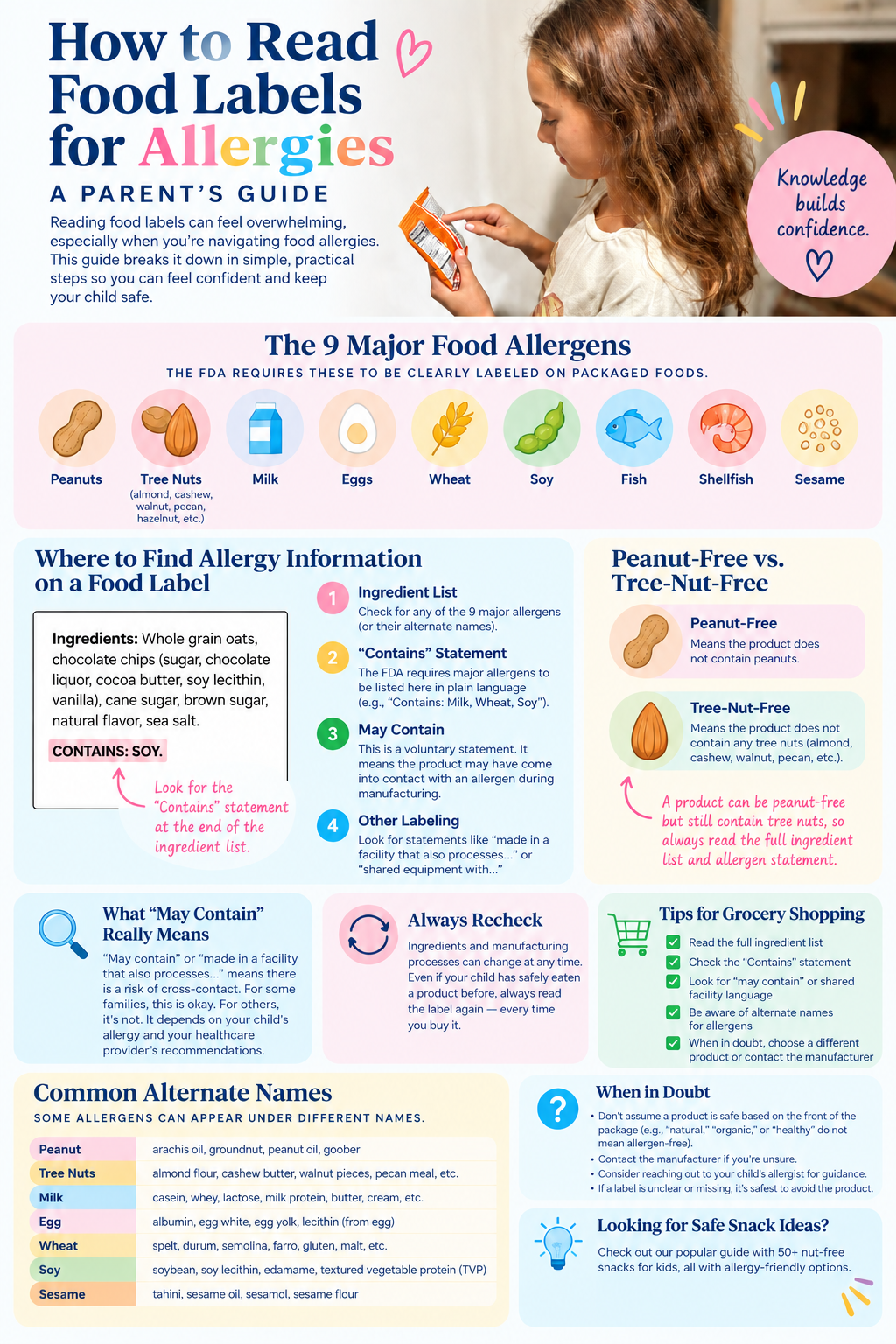
When you’re shopping for someone with a food allergy, a package label can feel like a lot to decode. The good news is that U.S. labeling rules give us several places to look for major allergens — but there are also important limits to what a label can tell you.
This guide walks through the label-reading routine I use as an allergy parent: check the ingredients, look for the allergen declaration, pay attention to advisory language, and check again every time you buy — even when it’s a product your family has eaten before.
Important: This guide is educational and is not individualized medical advice. Food ingredients and manufacturing practices can change. Follow your allergist’s guidance for the specific allergy you are managing, and contact the manufacturer when a label leaves you unsure.
Start With the 9 Major Food Allergens
Under current U.S. federal labeling rules, nine foods are considered major food allergens: milk, egg, fish, Crustacean shellfish, tree nuts, peanuts, wheat, soybeans and sesame. Sesame became the ninth major allergen effective January 1, 2023.
- Milk
- Egg
- Fish
- Crustacean shellfish
- Tree nuts
- Peanuts
- Wheat
- Soybeans
- Sesame
These rules are extremely helpful, but “major allergen” does not mean “the only foods people can be allergic to.” If you are managing an allergy outside the Top 9, ingredient reading can require additional care and guidance from your medical team.
Step 1: Read the Entire Ingredient List
Don’t rely only on a bold allergen statement at the bottom of the package. For FDA-regulated packaged foods, a major allergen used as an ingredient must be identified by its food source. Sometimes the ingredient name already makes the source clear. Other times the source appears in parentheses — for example, “lecithin (soy)” or “whey (milk).”
A separate “Contains” statement is one permitted way to declare major allergens, but not every product has to use that format. That’s why the full ingredient list matters.
Step 2: Look for the “Contains” Statement
If a package uses a Contains statement, it appears immediately after or next to the ingredient list and must identify the major allergens that are ingredients in that food. You might see something like:
CONTAINS: WHEAT, MILK, SOY.
If the allergen you need to avoid is listed there, the decision is easy: that product contains it. But the absence of a separate Contains statement is not a reason to skip reading the ingredients.
Step 3: Understand “May Contain” and Shared-Facility Language
This is where label reading gets less straightforward. Statements such as “may contain peanuts” or “produced in a facility that also uses tree nuts” are advisory statements about possible cross-contact. Under FDA rules, this type of advisory labeling is voluntary rather than a required standardized warning.
That means you should not assume that a product without a “may contain” warning has zero cross-contact risk. It also means the wording itself is not a reliable ranking of risk — for example, FDA has explained that “made in a facility” is not necessarily a lower-risk statement than “may contain.”
How your family handles advisory labeling is something to discuss with your allergist. If you need more information about a particular product, contact the manufacturer and ask about current ingredients and manufacturing practices.
Step 4: Know That Peanut and Tree Nut Are Different Allergens
A peanut is a legume; it is not a tree nut. Tree nuts include foods such as almonds, walnuts and pecans. U.S. labels must identify the specific type of tree nut when it is a major allergen ingredient.
Practically, this means a “peanut-free” claim should not automatically be read as “tree-nut-free,” and vice versa. Check the claim and ingredient information for the exact allergens your family avoids.
Step 5: Read the Label Every Single Time
This is one of the habits worth making automatic. Recipes, suppliers, packaging and manufacturing processes can change. The FDA specifically advises people with food allergies to check labels every time they buy a product, even if they have purchased and eaten it before.
My quick grocery-store check
- Read the complete ingredient list.
- Check the Contains statement, if there is one.
- Look for any advisory cross-contact language.
- Make sure I’m checking the exact allergen — peanut and tree nuts are not interchangeable terms.
- If anything is unclear, I don’t guess. I check with the manufacturer.
- I repeat the process the next time I buy it.
What Does “Nut-Free” Actually Mean?
One of the reasons we use careful wording throughout The UnRestricted Diet is that there is a meaningful difference between a manufacturer making an explicit allergy-related claim and simply not seeing peanuts or tree nuts in the ingredient information we reviewed.
On our snack guide, “Manufacturer Nut-Free Claim” means the manufacturer currently makes an explicit peanut/tree-nut-free or comparable claim. “No Nuts Listed in Ingredients” means the ingredient/allergen information reviewed did not list peanuts or tree nuts, but we are not treating that alone as a broader facility or cross-contact guarantee.
Looking for ideas after you’ve learned how to check the label? Browse our 50+ Nut-Free Snacks for Kids guide for school, sports, parties and everyday snacks.
A Few Label-Reading Traps to Avoid
- Only reading the front of the package. Marketing claims don’t replace the ingredient and allergen information.
- Only checking the Contains line. Read the complete ingredient list too.
- Assuming no advisory statement means no cross-contact. Advisory labeling is voluntary.
- Treating different advisory phrases as a risk scale. The wording alone does not tell you how much allergen, if any, may be present.
- Assuming the product hasn’t changed. Re-read familiar labels each time.
- Assuming every product from one brand has the same allergen profile. Check the exact product and package.
Frequently Asked Questions
Does a food have to have a “Contains” statement?
No. Major allergens must be declared as required by law, but the food source can be identified in the ingredient list rather than through a separate Contains statement. Read the entire ingredient list.
Does “may contain” mean the product definitely contains that allergen?
No. It is an advisory statement about possible unintended allergen presence from cross-contact. These statements are voluntary and are not a standardized measure of how much risk a product presents to a particular person.
If there is no “may contain” statement, is the product guaranteed free of cross-contact?
No. Advisory allergen statements are voluntary. If manufacturing information matters for your allergy-management plan and the label is unclear, contact the manufacturer.
Why should I check a label for a product we buy all the time?
Ingredients and manufacturing practices can change. FDA recommends checking the label each time you buy a food, even one you have eaten before.
Sources & safety note: This article is based on current U.S. FDA food-allergen labeling guidance. It is intended for general educational purposes and does not replace advice from your allergist or other qualified healthcare professional. Labeling rules can differ for certain foods and jurisdictions, and product formulations can change.


Leave a Reply